
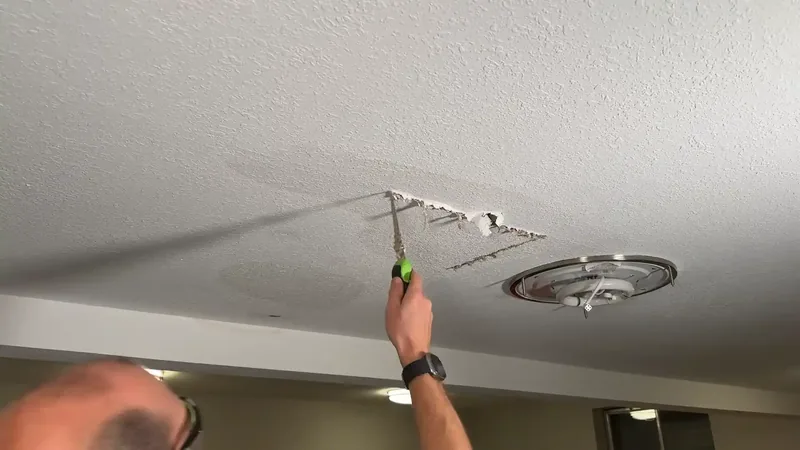
A brown ring on a ceiling is the visible record of a process that started somewhere above it, usually weeks before the ring appeared. The ring itself is not the water source. It is the terminal point of a path water traveled through insulation, along drywall paper, and down to a nail hole or a seam where enough volume accumulated to push through. Reading the clues in the stain pattern, and in the space above it, is the first step toward finding the actual source.
Reading the Stain Pattern
A ring stain with a darker edge and a lighter center indicates that the water reached the ceiling surface slowly and dried between episodes, concentrating the mineral residue at the outer edge. This pattern is consistent with an intermittent drip, such as a pinhole in a hot-water supply line that is active only when hot water is being used in the house. A uniform wet patch with no defined ring indicates a continuous source, such as a pressurized cold-water line that does not cycle.
The stain location relative to the room above tells you where to look first. If the stain is directly below a bathroom, the candidates are the toilet supply stop, the faucet supply lines under the vanity, the shower supply arm, or the drain P-trap. If the stain is in the center of a room with no bathroom above, the source is likely a supply line running through the joist bay, which is a pinhole in a copper run rather than a fixture connection failure.
The Pinhole Behind the Stain
In Longmont homes built between 1975 and 1995, the most common source of a ceiling stain with no obvious fixture above it is a pinhole in a copper supply line running through the ceiling joist bay. The copper was installed when the house was new, has been conducting medium-hard St. Vrain surface water for thirty to forty years, and has reached the point where interior mineral scale has thinned the pipe wall enough to perforate.
The pinhole itself may be in a section of pipe that is 2 to 4 feet away from the stain center, because water spreads along the top face of the drywall before penetrating. Acoustic detection listens through the ceiling drywall for the pressurized escape sound and can locate the failure within 12 to 18 inches. Thermal imaging of the ceiling surface maps where the wet zone extends, confirming the search area before any access cut is made.
What Not to Do
Do not cut out the stain ring to look for the pipe above it. The stain ring almost never aligns with the failure point. A homeowner who cuts a 12-inch square around the stain center frequently finds dry drywall and dry insulation directly above, because the water tracked laterally from a point several feet away. The access cut should be made after acoustic and thermal detection have identified the failure location, not before. In neighborhoods like Stoney Ridge, Lake Park, and Pioneer Park where 1990s copper is entering the failure window, this is an increasingly common call. Call (303) 552-3896 for ceiling leak detection and pinhole location in Longmont.