
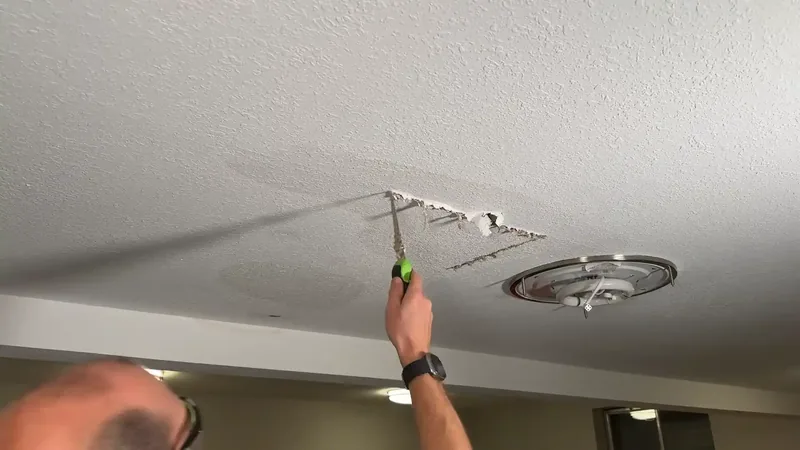
A brown ring on a ceiling is the end of a process, not the beginning. By the time the stain appears on the drywall face, water has already saturated the drywall paper, soaked through the gypsum core, and in most cases wet the top of the joist bay and the underside of the subfloor or the pipe chase above. The ring is the water that ran along the paper's hydrophilic surface and settled at a nail hole, a seam, or a low point. The source of the water is almost always several feet away from the stain perimeter.
In Longmont homes, ceiling leaks trace to one of three sources: a plumbing supply or drain line in the floor above, a shower pan or bathtub surround failure on the upper floor, or a roof penetration that allows rain or snowmelt infiltration. Distinguishing between these is the first task on every ceiling leak call, because the investigation method and the repair path differ completely.
How We Locate the Source
We begin with a walk-through of the space directly above the stain. If there is a bathroom, kitchen, laundry area, or mechanical chase above the ceiling, that narrows the field of candidates significantly. Thermal imaging of the ceiling surface reveals where the moisture extends beyond the visible stain ring, and a second thermal scan of the floor above can pinpoint the cold wet zone where a supply line has been dripping. We use moisture meters to test the subfloor boards in the room above, tracking the wetted pattern back toward the source.
For shower pan leaks, we perform a flood test: plug the drain, fill the pan to the curb height, hold for 24 hours, and recheck moisture readings below. This identifies a pan failure conclusively before any tile is removed. For plumbing supply leaks, acoustic detection through the subfloor can locate the pressurized exit point before we open the ceiling below.
Repair Without Unnecessary Demolition
Once the source is confirmed, the ceiling repair access is sized to the actual failure point, not to the stain ring. In most cases, a single ceiling panel or a targeted access cut of twelve to eighteen inches is sufficient to reach a failed coupling or pinhole section. We locate the leak to within a foot using acoustic and thermal tools, then open precisely there. Neighborhoods with the oldest pipe cohort, including Loomiller, Mill Village, and Old Town Longmont, see the highest frequency of ceiling leaks from aged copper supply lines in multi-story sections.
Frequently Asked Questions
Why is the water stain on my ceiling far from where the pipe is?
Water from a pinhole or pipe crack spreads laterally along the top of the drywall sheet before penetrating to the face below. The ring you see can be several feet away from the actual failure point. Thermal imaging maps where the moisture extends and acoustic detection locates the pressurized failure point above.
Do I need to open the whole ceiling to fix a ceiling leak?
Almost never. We locate the failure to within a foot using acoustic and thermal tools, then open a single targeted panel. The access point is sized to the repair, not to the stain on the ceiling below.
Can a ceiling stain be from the roof rather than a pipe?
Yes. We distinguish plumbing-source ceiling moisture from roof infiltration during the diagnostic walk-through. A stain that appears or grows only after rain events points to a roof source. A stain that grows independently of weather and is located below a bathroom or kitchen points to plumbing. We confirm the source before recommending any repair.