
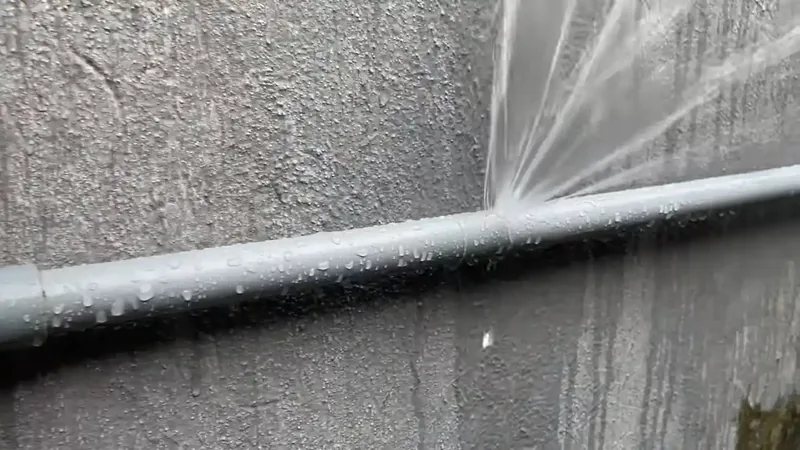
A pinhole leak is a small-diameter perforation in a copper supply line caused by internal corrosion. In Longmont, the corrosion mechanism is typically a combination of the medium-hard St. Vrain surface water depositing mineral scale inside the pipe over decades, and pitting corrosion initiating at scale-to-copper boundaries. The pinhole itself may be smaller than the tip of a ballpoint pen, but the pressurized water escaping through it acts as a jet that can silently wet framing, insulation, and drywall for weeks before a stain appears on the surface below.
Homes built between 1975 and 1995 carry the highest pinhole risk in Longmont. Copper supply lines in those houses have been in service long enough for scale to build to a critical thickness, and the pipe wall at the thinnest sections has lost enough material that failure rates across the city climb noticeably. Neighborhoods in this cohort include Spring Valley, Quail Crossing, Twin Peaks, and the northern sections of Wolf Creek.
Detecting Pinholes Before the Damage Spreads
A single pinhole in a ceiling cavity above a living space typically produces a stain pattern before it produces a drip at floor level. The water spreads laterally along the top face of the drywall sheet, wetting several square feet before enough volume accumulates to penetrate. By the time a homeowner sees the ring, the framing directly above has been wet for longer.
Acoustic detection uses sensitive ground microphones to hear the escape of pressurized water through a pinhole, even inside a wall cavity or ceiling joist bay. Thermal imaging maps the temperature differential between the cooled wet zone and the dry drywall around it. Together they allow us to mark the specific joist bay before opening any wall, keeping the repair access point to a minimum.
Repair Options for Pinhole Leaks
A single isolated pinhole in otherwise healthy copper can be spot-repaired with a coupling or short section replacement. But a first pinhole in 1985 copper is often not the only one that will appear. If a pressure test of the line shows that the wall thickness is marginal across the full run, a reroute or full repipe to PEX eliminates the recurring failure pattern. We give homeowners an honest assessment of adjacent pipe condition after the first repair, so they can make an informed decision rather than manage one pinhole at a time for several years.
For Old Town Longmont properties with galvanized steel supply lines, the failure mode is not pinholes but progressive narrowing of the bore and joint failures at threaded connections. Galvanized assessment and replacement follows a different evaluation path, described on the whole-house repipe page.
Frequently Asked Questions
What causes pinhole leaks in Longmont copper pipes?
Medium-hard St. Vrain surface water deposits mineral scale inside copper supply lines at elbows and velocity-change points over decades. Where scale builds unevenly, it creates corrosion cells that thin the copper wall until perforation occurs. Homes with 1975-to-1995 copper are in the highest risk window.
Should I patch one pinhole or repipe the whole system?
If the pinhole is isolated and the adjacent pipe tests as sound, spot repair is appropriate. If this is the second or third pinhole in an aging copper system, the economics and the disruption profile favor a repipe. We pressure-test the adjacent run after the first repair so you have the information to make that call.
How do you find a pinhole in a ceiling without tearing out all the drywall?
Acoustic detection hears the pressurized water escaping through the pinhole, even inside a ceiling joist bay. Thermal imaging maps where the wet zone extends. Together they locate the failure to within a foot, so we open a single panel rather than the full ceiling.