
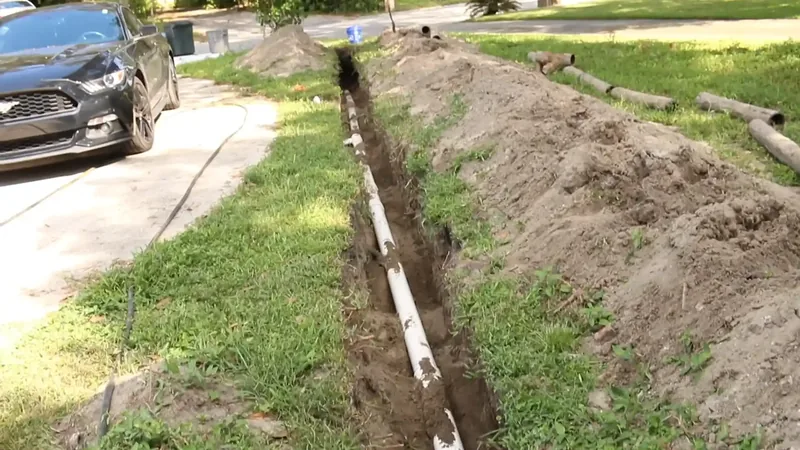
A sewer line failure is different from a water supply leak in one important way: there is no pressure to carry the signal to the surface. A supply line failure eventually announces itself through a water bill spike or a visible wet spot. A sewer failure works in silence, releasing wastewater into the surrounding soil without triggering any meter or moisture alarm. The first sign is often a soft spot in the yard above the line, a slow drain that resists snaking, or a sewer gas smell appearing in a room that has a seldom-used floor drain.
Longmont has two distinct sewer pipe eras in the ground. The original colony-era infrastructure in Old Town and Downtown Longmont was laid in clay or early cast iron in the late 1800s and early 1900s. Many of these lines are over a century old. The second wave, in post-war neighborhoods like Loomiller, Mill Village, and Southmoor Park, used cast iron and early Orangeburg pipe that has been in service for fifty to seventy years. Both eras are well past engineered design life.
How We Find Sewer Line Leaks
Camera inspection through the clean-out is the primary diagnostic tool. A push-rod camera shows the interior condition of the line from the foundation to the city connection, revealing root intrusion, offset joints, bellies where the line has settled, and sections where the pipe wall has corroded through. The camera footage is reviewed on-site with the homeowner so there is no ambiguity about what we found or where it is.
For leaks in the lateral near the house foundation, we use acoustic detection and soil moisture meters to confirm whether wastewater is saturating the soil before recommending excavation. In many cases a collapsed or offset section can be confirmed by camera and treated with trenchless pipe bursting or CIPP lining without digging up the yard.
Sewer Line Repair in Longmont
Spot excavation and section replacement handles isolated collapse or root intrusion at a single point. For longer runs of deteriorated clay or Orangeburg pipe, trenchless CIPP lining installs a new pipe-within-a-pipe through the existing clean-out access, preserving the landscaping above the line. For the colony-era lines in Old Town that have settled severely or show multiple offset joints, pipe-bursting replaces the full run without requiring a trench across the yard.
Bentonite expansive clay is a significant factor in Longmont sewer lateral condition. Clay soil movement over decades shifts the bedding under the pipe, creating the low points or bellies where waste accumulates. Adjacent communities including Firestone and Frederick use similar clay soil profiles and are served under the same response window.
Frequently Asked Questions
How do you detect a sewer line leak without digging up the yard?
A camera inspection through the clean-out shows the interior condition of the line from the foundation to the city connection. Acoustic detection and soil moisture meters confirm whether wastewater is saturating the soil above the line. We confirm the diagnosis before recommending any excavation.
How old are the sewer lines under Old Town Longmont?
The original colony-era sewer infrastructure in Old Town and Downtown Longmont was laid in clay pipe in the late 1800s and early 1900s. Many of these lines are over a century old and well past any engineered design life. Camera inspection is the only way to know the actual condition of a specific lateral.
Can you repair a sewer line without digging up my landscaping?
In many cases, yes. CIPP lining installs a new pipe-within-a-pipe through the existing clean-out without excavation. Pipe bursting replaces the full run with minimal excavation at the entry and exit points. We recommend the appropriate method after the camera inspection confirms the scope.