
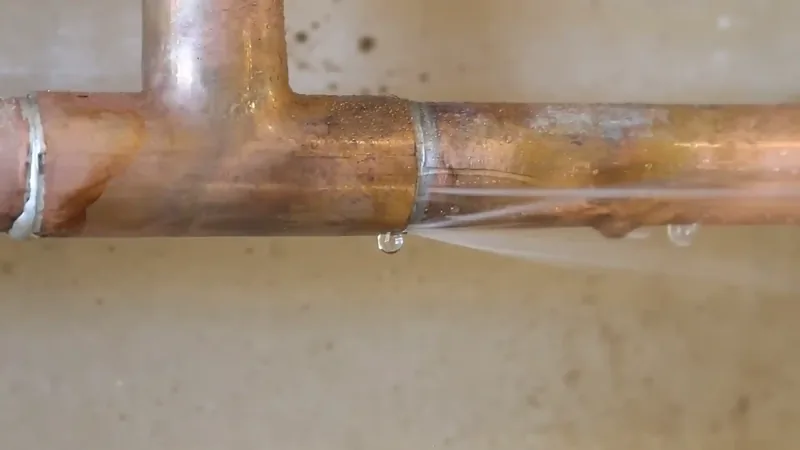
Copper was the dominant residential plumbing material in Longmont from roughly 1955 through the mid-1990s, covering the full build-out of the post-war neighborhoods and extending through the growth years of the 1980s. Homes in Southmoor Park, Spring Valley, Twin Peaks, Westview, and Quail Crossing are overwhelmingly copper-supplied. That copper is now between thirty and sixty years old, and in the presence of medium-hard St. Vrain surface water it has been accumulating internal scale for the full duration of its service life.
The failure mechanism most common in Longmont copper is dezincification pitting and scaling-initiated pinhole corrosion. The city's water from the St. Vrain watershed and C-BT project is treated at the Nelson-Flanders and Wade Gaddis plants and is classified as medium hard. Medium-hard water deposits calcium carbonate scale inside copper at elbows and velocity-change points. Where scale deposits unevenly, it creates differential corrosion cells that thin the copper wall beneath the scale layer until perforation occurs.
Signs of Copper Pipe Failure in Longmont
Early signs include a water bill that has increased without any change in household usage, a faint sound of running water audible near the water heater or in a basement utility area with all fixtures off, and blue-green mineral staining on exposed copper fittings in the mechanical room. The blue-green coloration indicates active copper leaching, which accompanies the corrosion process that precedes pinhole failure. A water meter that moves when all fixtures and appliances are off is a confirmatory signal that an active supply failure is present somewhere in the distribution system.
Copper Pipe Repair and Replacement Options
Spot repair with a copper coupling or short section addresses an isolated failure in otherwise sound pipe. Acoustic detection and thermal imaging locate the failure point before any wall is opened. For homes where the copper is uniformly aged across the full system, we evaluate whether a whole-house repipe to PEX-A makes more economic sense than managing individual failures as they appear over the coming years. We provide the assessment honestly and without steering toward the larger project if the spot repair is the correct answer.
Frequently Asked Questions
How long does copper pipe last in Longmont?
Copper supply lines in Longmont's medium-hard water environment typically reach the pinhole failure window at thirty to fifty years of service. Homes with 1975-to-1995 copper are now in that range. Individual pipes can vary; pressure testing and visual inspection of fittings gives a site-specific condition assessment.
What does blue-green staining on my copper fittings mean?
Blue-green verdigris on exposed copper fittings indicates active copper leaching, which accompanies the corrosion process that precedes pinhole failure. It is a sign that the existing pipe is in active degradation, not just aging in place. We assess the surrounding pipe condition when this is present.
Is it worth repairing copper pipe or should I switch to PEX?
A single isolated failure in otherwise sound copper is worth repairing. If this is a recurring failure in a home with uniform 1980s copper throughout, the economics favor a full repipe to PEX-A, which eliminates the corrosion mechanism entirely. We give you both options and the honest trade-off between them.