
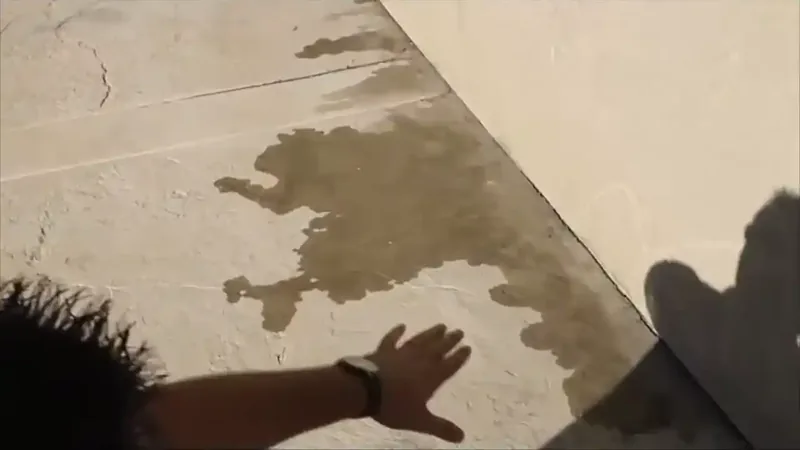
A slab leak diagnosis comes with an immediate question: how much is this going to cost? The honest answer is that the cost range is wide, and where your repair falls in that range depends on three factors: where exactly the leak is, what repair method is appropriate for that location, and the condition of the surrounding pipe. Here is how those factors work in practice for Longmont homes.
Option 1: Spot Repair (Targeted Saw Cut)
If acoustic detection and thermal imaging locate the leak to within a foot or two of the actual pipe failure, a targeted saw cut in the concrete above that point allows a plumber to expose the failed section, cut out the cracked or pinholed segment, and install a coupling repair. The concrete patch follows after the repair is pressure-tested.
Spot repair is appropriate when the adjacent pipe is in sound condition, when the failure is a single isolated crack or pinhole rather than a section of deteriorated pipe, and when the pipe can be accessed without cutting through a finished basement floor. In an unfinished utility basement in a Spring Valley or Twin Peaks home, a spot repair on an accessible section of concrete may run $800 to $1,500 all in. In a finished basement with tile flooring, the concrete work plus the flooring repair adds significant cost beyond the plumbing itself.
Option 2: Reroute (Bypass)
A reroute abandons the failed slab-embedded section entirely and installs a new pipe run through an accessible wall or ceiling path. For a hot-water slab line that runs from the water heater through the slab to a bathroom on the far side of the house, a reroute might run the new line through the wall cavity behind the water heater, across the basement ceiling, and up into the bathroom wall from above rather than below.
Reroute avoids concrete work entirely. The tradeoff is that the new pipe route may require more linear footage of new pipe, more drywall access cuts, and more labor than a targeted slab cut. In Longmont homes where the slab failure is under a finished tile floor or a concrete section that is particularly deep, a reroute is usually the more economical option even though it involves more pipe. Reroute repairs typically run $1,500 to $3,500 depending on the complexity of the new path.
Option 3: Full Repipe
When a slab failure is the second or third supply line failure in the same house within a few years, or when a pressure test of the adjacent slab pipe shows significant wall thinning across a long run, a full whole-house repipe to PEX-A becomes the most economical option on a five-year horizon. The upfront cost is higher, typically $5,000 to $12,000 for a standard Longmont single-family home depending on size and pipe access complexity, but it eliminates the recurring failure pattern entirely and replaces the aging copper with a material that does not scale internally under St. Vrain water chemistry.
| Repair Option | Best Fit | Typical Longmont Range | Disruption |
|---|---|---|---|
| Spot repair | Single isolated failure; unfinished floor access | $800-$1,500 | One saw cut; minimal |
| Reroute / bypass | Finished floor over slab; accessible wall path | $1,500-$3,500 | Drywall cuts; no concrete |
| Epoxy pipe lining | Structurally sound pipe with interior scaling | $2,000-$5,000 | No demolition |
| Full repipe (PEX-A) | Recurring failures; aged copper system-wide | $5,000-$12,000+ | Room-by-room; 2-3 days |
The Variable That Changes Everything: Detection Precision
The single most important cost factor is how precisely the leak is located before any concrete is touched. A spot repair performed based on a general area estimate rather than a precise acoustic and thermal location can require two or three exploratory cuts before the failure is found. Each extra cut adds concrete demolition cost, patching cost, and in a finished basement, flooring replacement cost. Paying for thorough detection upfront consistently produces lower total repair costs. Call (303) 552-3896 to schedule acoustic and thermal slab leak detection in Longmont.