
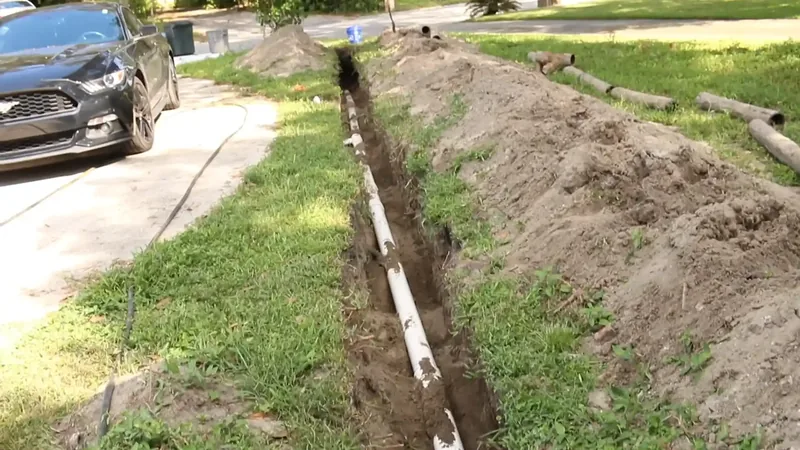
A sulfur or sewage smell rising from the yard or from a ground-floor drain in a Longmont home, particularly in Old Town and Downtown neighborhoods, is one of the more reliable indicators that a sewer lateral is failing underground. The odor comes from hydrogen sulfide and organic decomposition gases escaping through a crack, offset joint, or corroded-through section of the lateral pipe. In most cases, the smell is detectable before visible sewage intrusion appears, which makes it one of the earlier warning signs available.
Colony-Era Sewer Infrastructure in Old Town Longmont
The Chicago-Colorado Colony platted Longmont in 1871. The first sewer infrastructure dates to the 1880s and 1890s, with systematic expansion through the early 20th century. The laterals connecting individual lots to the street main during this period were typically vitrified clay pipe, a ceramic material that is durable in stable soil but brittle in soil that moves. Longmont's bentonite expansive clay does not stay stable. A century of expansion and contraction cycles has shifted the bedding under these clay laterals repeatedly, cracking some segments and offsetting others at the bell-and-spigot connections that join clay pipe sections.
Cast iron pipe replaced clay in many Old Town and Downtown Longmont lateral installations during mid-century updates, but cast iron that has been in the ground for fifty to seventy years faces its own failure mechanism: corrosion of the pipe wall from both outside (soil-side) and inside (hydrogen sulfide attack from the sewage stream). When the cast iron wall corrodes through, a small hole in the buried pipe is the result. Soil and groundwater can enter through that hole, and sewer gases exit.
Root Intrusion Through Lateral Joints
Old Town Longmont's mature tree canopy, much of it established in the early and mid-20th century, has extended root systems through the block-and-yard area that the sewer laterals traverse. Tree roots seek moisture and nutrients, and a sewer lateral provides both. A root hair that enters a clay or cast iron joint in search of moisture will grow to fill the available space over years, eventually blocking the lateral to the point where solids cannot pass. The initial symptom is a slow drain that resists standard snaking because the roots recolonize the lateral within days of being cleared.
A camera inspection through the clean-out shows the root situation in the lateral visually, without any excavation. Roots appearing at multiple joint locations indicate that the full lateral is a root-intrusion candidate rather than a single-point blockage. CIPP lining through the existing clean-out restores the full bore of the lateral and seals all joint entry points without excavating the yard. For laterals that are severely offset or collapsed, pipe bursting replaces the full run with minimal excavation at the entry and exit points.
If you smell sewage in the yard near the street in Old Town or Downtown Longmont, call (303) 552-3896. We perform camera inspection first and show you what the lateral looks like before recommending any repair.